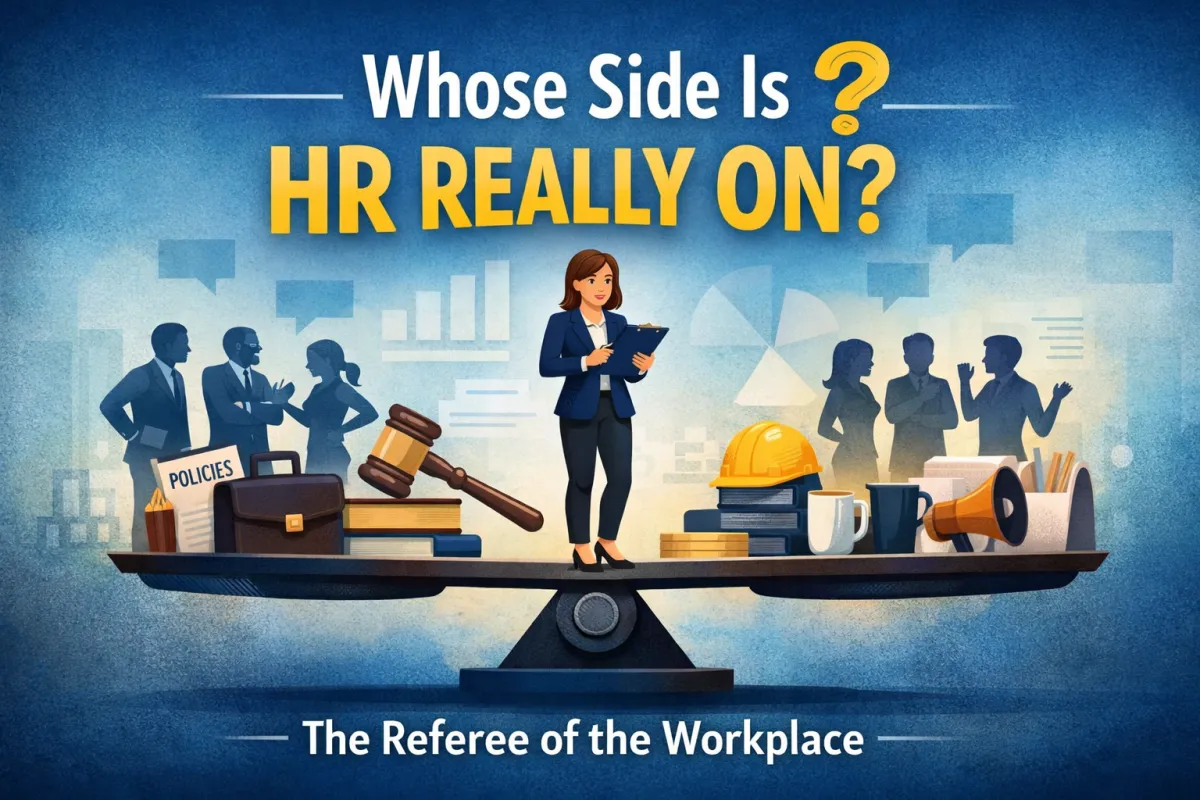
The Great HR Myth: “Whose Side Are You On?”
The Great HR Myth: “Whose Side Are You On?”
Written by: Laura Donohoe
Here’s a question HR professionals, including myself, have been asked since approximately the beginning of when HR or the Personnel department were founded (or at least since the first employee handbook was printed):
“Whose side is HR on?”
Employees ask it quietly in break rooms as if they’ve uncovered a corporate conspiracy.
Managers ask it when HR won’t let them terminate someone via Slack or a MS Teams message at 9:47 p.m. Executives sometimes ask it when HR suggests that maybe, just maybe, yelling at staff during meetings isn’t a leadership strategy.
Apparently, HR is either:
A secret agent for the company, protecting the employer at all costs
or
A soft-hearted advocate for employees, constantly interfering with “business realities.”
And depending on who you ask, we’re doing one or both of those jobs terribly!
Here’s the truth most people don’t want to hear…
HR isn’t on anyone’s side.
Not the employer’s.
Not the employee’s.
And after enough years in the profession…some days not even humanity’s.
But why you ask?
From the employer’s perspective…
Many employers assume HR exists to protect the company and keep employees in line.
Which would be great…if employers actually listened to HR!
In reality, HR spends a surprising amount of time saying things like:
• “You probably shouldn’t say that in writing.”
• “Yes, policies apply to executives too.”
• “No, you cannot terminate someone because she’s pregnant and going to be out too much.’”
• “Please stop creating liability.”
To which employers often respond with:
“Why is HR making this so complicated?”
Because employment law exists.
Because documentation matters.
Because treating people fairly tends to reduce lawsuits.
And how about the biggest one…it’s just not the right thing to do?!
These are apparently controversial positions.
From the employee’s perspective…
Employees often believe HR exists purely to protect the company.
You’ve heard it before:
“HR isn’t your friend.”
This is usually said right after HR explains that policies, procedures, and federal law apply to everyone, including the person making the complaint.
Employees may come to HR expecting immediate justice, emotional validation, and possibly a ceremonial firing.
When HR responds with things like:
• “Let’s investigate the situation.”
• “We need to hear both sides.”
• “There may be some context here.”
…suddenly HR becomes the villain of the story.
The reality? HR is the referee nobody likes.
Our job is to help organizations function legally, ethically, and operationally while navigating the complexities of human behavior.
That means balancing things like:
• Compliance
• Business realities
• Employee relations
• Leadership expectations
• Organizational culture
And occasionally reminding adults to behave like adults.
It’s less “taking sides” and more constant balancing.
Imagine refereeing a game where:
• Both teams think the rules only apply to the other side
• Everyone believes they’re right
• Nobody actually reads the rulebook
• And the crowd boos every decision
Congratulations.
You’ve just described HR ;-).
A small confession from someone who has spent years in this field…
After enough time working in HR, you realize something important:
Employers can be selfish.
Employees can be selfish.
And both sides are often convinced their perspective is the only one that matters.
Some employers forget employees are human beings.
Some employees forget businesses have to operate successfully to exist.
And somewhere in the middle is HR…holding policies, laws, and organizational strategy together while everyone else debates who is “right.”
So whose side is HR on?
None.
HR’s role is not to pick sides.
HR’s job isn’t to choose sides.
It’s to keep the organization balanced, functional, and legally compliant while navigating the very complicated reality of human behavior.
And if we’re lucky…
Everyone walks away slightly less frustrated than when they started.
But let’s be realistic.
That part rarely happens.
